
Weeks 1–2
Pain
Settle the ache, get the swelling down.
Manual therapy and dry needling into the hip, glute and quad tissue that’s been guarding, plus swelling control and cupping when the outside of the joint is the loud part.
What We Treat
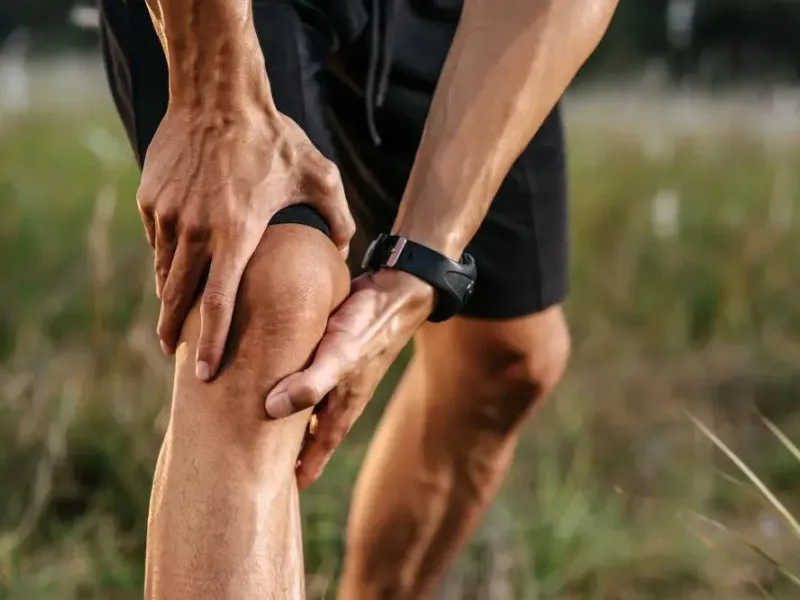
That pinch in the crease every time you get out of the car. Stairs you take one at a time, leading with the good leg. Hip and knee pain show up together more often than not, and it’s fixable, starting with a cause-first evaluation, not a guess.
Sound Familiar?
Two or more? Keep reading.
Why It Happens
Your hip carries your whole body weight on one leg, thousands of times a day. It handles that fine as long as the glutes do their share. When they stop, the joint, the labrum and the tendons on the outside pick up the load instead, and a hip that isn’t controlling rotation lets the knee drift inward on every step below it. The knee is a hinge that mostly goes one direction, which makes it excellent at its own job and terrible at absorbing everyone else’s. It sits in the middle and eats what the hip above it and the ankle below it can’t handle.
That’s why guessing from the sore spot goes wrong so often. It takes a cause-first evaluation to separate hip from knee, joint from tendon, and figure out which one is actually driving the other. Find the real cause and the fix stops being a brace, a stretch, and a hope.
The Honest Truth
Nobody walks in here wishing they had waited longer. The sentence we actually hear is “I wish I’d done this sooner.”
How We Fix It
Every plan has an endpoint. Here’s what the four phases look like for hip and knee pain.
Weeks 1–2
Pain
Manual therapy and dry needling into the hip, glute and quad tissue that’s been guarding, plus swelling control and cupping when the outside of the joint is the loud part.
Weeks 2–6
Prime
Getting out of the car and off the floor stop being an event. Joint mobilization gives the hip and knee room to travel through their full range instead of pinching at the end of it.
Weeks 6–10
Perform
This is the part most hip and knee plans skip. Progressive glute and quad loading, with blood flow restriction when the joint isn’t ready for heavy yet.
Weeks 10+
Prevent
Squatting, stairs and running get retested under real load before you’re cleared, with a running assessment if that’s your sport. That’s the endpoint, not another appointment.
I had hip pain so bad that I could not get rid of it, and came in to see Joe and he made it so i could squat heavy and run again without my hip sending pain down my leg in about a month of appointments!
Shared by Royce C. · Hip pain
Denisse Fernández is an outstanding physical therapist. She is professional, knowledgeable, and truly cares about her patients. After just a few sessions, my knee pain was gone, and I didn’t need to take any pain medication.
Shared by Maria L. · Knee pain
Today: leading with the good leg, one at a time
The goal: squatting heavy and taking the stairs without thinking about it
Questions, Answered
That’s the right question, and it’s the most common mix-up we see. Hip joint problems usually speak up in the groin or deep in the crease. Pain running down the leg often comes from the spine instead, and a knee that aches can just as easily be paying for a hip that isn’t doing its job. We test all three on the table in the same visit, so you leave knowing which one is actually driving it.
No. Wear and tear shows up on imaging constantly, including in hips and knees that have never hurt a day. What decides how the joint feels week to week is how much load the muscles around it take off. That part is trainable at any age. We treat the joint in front of us, not the picture of it.
Sometimes surgery is the right call, and often it isn’t the first one. Plenty of hips and knees settle down once the glutes, quad and ankle start doing their jobs again. A cause-first evaluation tells you which category yours is in. If you genuinely need a surgeon, we’ll say so plainly and help you walk in there strong, which makes the recovery shorter on the other side.
Squatting isn’t the problem. Squatting more than your joints are currently prepared for is the problem. Hips and knees are built to bend under load, and they get stronger when that load climbs on a sensible curve. We find the depth and the weight you tolerate today, then move that line every week.
Usually yes, with the dose adjusted. We’d rather change your mileage, your depth and your tempo than take your sport away, because losing your fitness creates its own problem. Occasionally something does have to pause for a short window. If that’s you, you’ll hear exactly why, what has to happen, and what gets you back.
You get a plan with an endpoint, and you’ll have it before you leave your evaluation. Every plan runs the same four phases: Pain, Prime, Perform, Prevent. How long each one takes depends on how long the hip or knee has been compensating and what you want to get back to. You’ll always know which phase you’re in and what’s left, instead of an open tab of appointments.
Book Your Visit
Request a time and a real person calls you back. No phone tree. No ‘someone will reach out.’ Just a plan.
5.0 · 300+ Google reviews
A real person calls you back
Step 1 of 5
That’s the hard part done. We’ll call during business hours to lock in your time.
Visit Us