
The case for wide toe box shoes.
Your foot is widest at the toes. Almost every shoe you own is narrowest there. That mismatch shows up as pain.
January 1, 2022
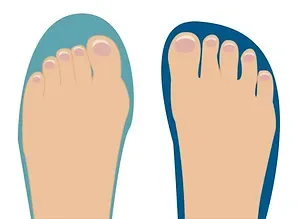
Take off your shoe and look at your foot
Stand up barefoot. Look down. Your foot is widest across the ball and the toes, and your big toe points more or less straight ahead.
Now look at the shoe you just took off. It is almost certainly widest in the middle and tapers to a point at the front.
Those two shapes do not match. One of them has to give, and it is not the shoe.
Why the shape of the front of the shoe matters
Your toes are not decoration. They are the last thing to leave the ground on every step you take.
When they can spread, the front of your foot becomes a wide, stable base. Your big toe can do its job of pushing off. The small muscles inside your foot get to work.
When they are squeezed into a point for twelve hours a day, that base narrows. Your big toe gets angled inward. Load that should be shared across the whole forefoot gets funneled into a smaller area.
That is a mechanical problem, and mechanical problems show up as symptoms somewhere. Sometimes at the toes. Often further back, at the arch, the heel, even the knee and hip.
What to actually look for in a shoe
Forget the marketing on the box. Check these five things in the store.
- The outline. Pull the insole out and stand on it. If your foot spills over the sides at the toes, the shoe is narrower than you are.
- A straight inside edge. The line from your heel to your big toe should be roughly straight, not curved inward.
- Room to wiggle. You should be able to spread your toes inside the shoe while standing, not just lying flat.
- A soft, flexible upper. A wide sole under a tight upper still squeezes. The material over your toes should move.
- Length you actually need. Wide is not the same as long. A shoe that is too long slides and makes you grip with your toes.
Cushioning is a comfort preference. Shape is a fit problem. Fix the shape first.
Who should care about this
- Anyone with a bunion, or a big toe that is drifting toward the second one
- Anyone with pain across the ball of the foot, or numbness and burning between the toes
- Anyone dealing with plantar fasciitis or first-step-in-the-morning heel pain
- Runners, especially if the miles are going up
- Nurses, teachers, trades, anyone on their feet all day
- Anyone with recurring foot or ankle pain that no one has explained
Two honest warnings
First, change it gradually. If your feet have been in narrow, cushioned, high-heeled shoes for twenty years, they are not ready for a full day in something completely different. Start with short walks and build.
Second, a shoe is not a treatment plan. A wider toe box takes a stressor off your foot. It does not strengthen the muscles that got weak, restore the motion you lost, or fix why the load was going through that spot in the first place.
That is the part we do. If you have been chasing foot pain from one pair of shoes to the next, the shoe was probably never the whole story.
Get it looked at properly
A cause-first evaluation takes an hour, one-on-one with a Doctor of Physical Therapy. You leave knowing what is actually driving the pain and what the plan is to end it.
Request an appointment, or call (210) 750-9004.
Book Your Visit
Ready when you are.
Request a time and a real person calls you back. No phone tree. No ‘someone will reach out.’ Just a plan.
- Hours Mon to Thu 6:30am to 7pm, Fri and Sat 6:30am to 12pm, Sun closed
- (210) 750-9004 Prefer to talk now? Call us.
- No referral needed to get started
5.0 · 300+ Google reviews
A real person calls you back
Step 1 of 5
Request sent.
That’s the hard part done. We’ll call during business hours to lock in your time.